
There’s a specific kind of camping trip where everyone arrives with the right gear for a different trip. The sleeping bag rated to 30°F when it’s 78°F overnight. The jeans. The single water bottle. July camping — especially in humid climates like the Northeast — has specific packing requirements that fall-camping habits don’t prepare you for, and the difference between a comfortable summer camping trip and an exhausting one is mostly in what’s in the bins before you leave home.
Clothing: Fewer Items, Better Choices
July camping clothing is defined by what you leave out as much as what you bring. The instinct to overpack — to bring options for every scenario — produces a suitcase full of things that never come out of the bag and a shortage of the things you actually use every day.
The Textile Decision
Cotton is the enemy of hot-weather camping comfort. Cotton absorbs moisture and holds it against your skin, producing the specific clammy feeling that makes a 82°F humidity day feel worse than a 90°F dry day. Moisture-wicking synthetic fabrics (polyester blends, nylon) and merino wool both perform dramatically better — they move sweat away from the skin and dry quickly. For a July camping trip, replace every cotton T-shirt in the packing pile with a moisture-wicking equivalent and the comfort difference over a four-day trip is substantial.
Light colors matter more than you’d think. Dark fabrics absorb significantly more solar radiation than light ones — on a day with direct sun, the difference between a white and a navy shirt can be a 5-10°F surface temperature difference that translates directly to how hot you feel while wearing it.
What to Actually Pack
Two or three moisture-wicking short-sleeve shirts per person. One pair of quick-dry shorts per person per day — these are the workhorse item and they wash and dry overnight at most campgrounds. A light long-sleeve layer for evenings (Lake Champlain evenings can drop into the 60s even in July — pleasant, but requiring a layer after the sun goes down). One pair of pants for the evening campfire and any day that calls for more coverage. Swimwear — at least two sets if water access is part of the trip, so one is always dry. Water shoes for rocky lake entries and river access points. Closed-toe shoes for hiking. Sandals for camp. That’s a complete wardrobe for a week of July camping that fits in a bag smaller than the one most people bring for a weekend trip.
“The most useful packing rule for July camping in the Northeast: if it’s cotton and it’s not a towel, leave it at home.”
Sun Protection: More Than Most People Bring
Sun protection in a summer camping context is more demanding than a beach day, for one counterintuitive reason: you’re outdoors for 12 to 16 hours rather than 3, and the cumulative UV exposure over a full camping day is substantially higher than what you’d accumulate at the beach for an afternoon. Most people apply sunscreen once and consider the task complete. At 10 a.m. A camping day that runs 6 a.m. to 9 p.m. without reapplication is a recipe for sunburn even with SPF 50 applied at the start.
The Sunscreen Math
SPF 50 blocks approximately 98% of UVB radiation when applied correctly and reapplied on schedule. The FDA recommends reapplication every 2 hours during sun exposure and immediately after swimming or heavy sweating. On a July camping day with a morning hike, afternoon lake swimming, and an outdoor dinner, that’s potentially 5-6 applications — which requires far more sunscreen than a single tube typically contains. Plan for a 3-4 ounce bottle per person per day of outdoor activity, not the 1-ounce travel size that runs out before the first swim.
Wide-brim hats provide UV protection for the face, ears, and neck that sunscreen alone doesn’t fully address. UPF 50+ sun shirts provide consistent protection for the areas they cover without requiring reapplication — particularly valuable for outdoor activities where constant reapplication is impractical. Sunglasses with UV400 protection (not just “UV blocking” marketing language, but specifically UV400 rated) protect against both UVA and UVB reaching the eyes.
Hydration Infrastructure: More Than Water Bottles
The difference between a hydration system that works for a July camping trip and one that doesn’t is the difference between drinking enough water and almost drinking enough water. The camping version of “almost enough” produces afternoon headaches, reduced energy, and the general degradation of the trip experience that doesn’t get linked to dehydration because it arrives gradually.
The Insulated Container Problem
A standard non-insulated water bottle in 85°F sun produces warm water within 30 minutes. Warm water is less appealing to drink and actively hot water is harder to keep drinking in sufficient quantity. Insulated stainless steel bottles — the 32-ounce double-walled type — keep water genuinely cold for 8-12 hours in summer conditions, which makes actually drinking the necessary quantity throughout the day significantly easier. One per person, minimum. This is the single most impactful hydration upgrade for a hot-weather camping trip.
A large insulated cooler with sufficient ice for the trip duration keeps electrolyte drinks, cold snacks, and additional water genuinely cold. The math on ice is always underestimated: a standard 50-quart cooler packed with room-temperature contents and covered ice in 85°F ambient temperatures uses ice significantly faster than the same cooler packed in a shaded position with pre-chilled contents. Pre-chill the cooler interior and all contents the day before departure. Pack ice on top of contents rather than underneath (cold air falls). Minimize lid openings. These practices extend ice life by 30-50% in summer conditions.
Electrolytes: Not Optional in Humidity
Humidity increases sweat rate at any given temperature because the sweat evaporates less efficiently, requiring more of it to achieve the same cooling effect. The result is a higher rate of sodium, potassium, and magnesium loss than most people compensate for with water alone. Electrolyte drink mixes, salt tablets, or electrolyte-rich snacks are not a performance athlete concern — they’re a practical heat management tool for anyone doing outdoor activity in summer humidity. A headache that arrives at 3 p.m. on a hot, humid camping day is usually a dehydration/electrolyte deficit presenting, not a medical problem. Address it with electrolytes and water before it becomes one.
The Campsite Setup Items That Matter in Summer
Several campsite setup items earn their cargo space in July that would be optional in October.
Shade Creation
A large portable shade structure — a 10×10 or 10×20 canopy — is the summer camping upgrade that changes the character of the midday hours. The air temperature under a shade canopy with any breeze is 10-15°F cooler than full sun at the same ambient temperature. On the days when the Adirondack foothills push into the low 90s, that 10-15°F is the difference between comfortable outdoor sitting and retreating to the car’s air conditioning. A canopy with side walls provides wind break function as well as shade, which is useful for the Lake Champlain area where wind off the water can make a partially cloudy day unexpectedly breezy for a meal setup.
Battery-Powered Fan
A rechargeable or battery-powered fan for the tent or the campsite table is more effective than most people expect at reducing the felt temperature during still-air periods. Airflow across the skin increases evaporative cooling by the same mechanism as natural wind — moving air doesn’t lower the air temperature, but it significantly accelerates the evaporative cooling of perspiration, which is the body’s primary thermoregulation tool. A small USB rechargeable desk fan running through the night in a well-ventilated mesh tent can make the difference between sleeping and not sleeping on an 80°F night.
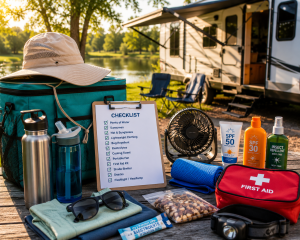
Clothing: moisture-wicking fabrics only. Light colors. 2-3 shirts, quick-dry shorts daily, light evening layer, 2+ swimwear sets, water shoes, sandals, one hiking shoe.
Sun protection: SPF 50 sunscreen — 3-4 oz per person per day. Wide-brim hat. UPF 50+ sun shirt. UV400 sunglasses.
Hydration: 32-oz insulated stainless bottle per person. Electrolyte drink mixes or salt tablets. Pre-chilled insulated cooler with calculated ice quantity.
Campsite: 10×10 or 10×20 shade canopy. Rechargeable fan. Dark-colored tent avoided if possible — lighter colors absorb less solar heat.
Bug protection: DEET or picaridin-based insect repellent. The Northeast in July is prime mosquito and tick season. Treat clothing with permethrin for hikes.
Sleep: sleeping bag liner rated for 60-70°F rather than a full bag for most July nights. Inflatable mattress pad creates air gap from warm ground.
For guests staying at Lake Champlain RV Park, the Lake Champlain campground information covers site specifics and what to expect on arrival. For guests considering cabin accommodations — which provide built-in AC and eliminate several of the heat management considerations above — the Lake Champlain cabin options cover what’s available and how to book.
Frequently Asked Questions
What is the most important thing to pack for a July camping trip?
If forced to choose one item, an insulated 32-ounce water bottle per person — the double-walled stainless steel type that keeps water cold for 8-12 hours — has the highest impact on overall trip comfort of anything on the list. Dehydration is the most common source of degraded camping experience in summer, and the reason people don’t drink enough is usually that warm water is unpleasant to drink in sufficient quantity. Cold water is significantly easier to drink consistently throughout the day, and the consistent hydration it enables affects energy, mood, and physical performance more than any other single item. After that: sufficient sunscreen (3-4 oz per person per day, not 1-oz travel size), electrolyte supplements, and moisture-wicking clothing.
What type of tent is best for hot and humid camping weather?
For hot and humid summer camping, the key tent features are maximum mesh panel coverage for airflow, a light-colored outer fly (tan, grey, or off-white rather than dark green or navy — dark colors absorb significantly more solar radiation), a double-wall design where the inner tent is primarily mesh with the fly providing weather protection above, and size that allows the interior to breathe without the walls pressed against occupants. Three-season tents optimized for summer use typically have more mesh and lighter colors than four-season or expedition tents. A large footprint also helps — a 4-person tent used by 2 people provides significantly more airflow than the same tent at full capacity. Avoid single-wall designs in humid conditions, as condensation management becomes an issue.
How do I keep food cold during a summer camping trip?
The key practices for extending ice life in summer conditions: pre-chill both the cooler interior and all food items in the refrigerator the night before departure (putting room-temperature items into a cooler immediately begins consuming ice capacity before the trip starts). Pack ice on top of food rather than underneath — cold air falls, so top-loaded ice keeps contents colder more efficiently. Keep the cooler in the shade and avoid unnecessary lid openings. A 2:1 ice-to-content ratio maintains cold significantly longer than the 1:1 ratio most people use. Quality hard-sided coolers (Yeti, RTIC, Pelican) provide substantially better ice retention than inexpensive foam coolers and are worth the investment for frequent summer campers. Dry ice used in combination with regular ice provides dramatically extended cold retention but requires careful handling — dry ice burns on contact with bare skin.
What should I bring for sleeping comfortably in summer camping heat?
For July camping in the Northeast where overnight lows typically drop to the mid-60s°F, a sleeping bag liner rated for 60-70°F — used without a full sleeping bag — or a lightweight quilt is typically all that’s needed for sleep comfort rather than a 3-season sleeping bag rated to 30-40°F that would cause overheating. A battery-powered fan for tent airflow is the sleep upgrade with the highest impact — moving air across the skin during sleep significantly reduces the felt temperature without lowering the actual air temperature. A mesh sleeping bag inner tent layer (the inner tent panel being mostly mesh rather than solid fabric) allows airflow that a tent with solid inner walls doesn’t provide. Keep the fly vented where possible to allow convective air exchange.
Is bug protection necessary for summer camping near Lake Champlain?
Yes — the Lake Champlain region in July is active mosquito territory, and the Adirondack foothills have tick populations that require attention for anyone walking through brush or tall grass. The most effective approach: DEET-based repellent at 25-30% concentration or picaridin-based repellent for skin application (picaridin is odorless and non-greasy, which some users prefer). For hiking and trail activities, treating clothing and gear with permethrin-based spray provides persistent protection against ticks that DEET-based skin repellents don’t fully address — permethrin bonds to fabric and remains effective through multiple washes. Perform full tick checks after any brush contact or hiking activity, particularly on the scalp, behind the ears, in the armpits, and behind the knees where ticks prefer to feed.
How much sunscreen should I pack for a week-long July camping trip?
The practical calculation: SPF 50 sunscreen should be reapplied every 2 hours during sun exposure and after swimming or heavy sweating. On a full outdoor day of 12-14 hours with swimming, that’s 4-6 applications. Each application for an adult covering face, neck, arms, and legs requires approximately 1-1.5 ounces of product. That’s 4-8 ounces per person per full outdoor day. For a week-long camping trip with 7 full outdoor days, a conservative estimate is 2-3 standard 8-ounce tubes per person. Most people bring one 3-ounce travel tube and run out by day two. Over-packing sunscreen is one of the most benign over-packing decisions you can make — it’s cheap, it stores indefinitely, and running out of it in the field produces sunburn that ruins the remaining trip.